Capital is live: your customers can stop filling in forms
The first Slate product is out. A fixed advance, sized from data your platform already holds, offered inside your product on the day it is useful.
Advance balance
$9,660.00
Next payment, Wed Mar 19
$1,150
Payments
Capital
A fixed advance, offered inside your product on the day it is useful.
Today we are turning on the first thing we built. It is called Capital, and it does one unglamorous job very well: it puts a fixed amount of money inside your product, on the day one of your customers needs it, without anybody filling in a form.
That is the entire pitch. I am aware it does not sound like a launch. Bear with me.
The part that annoyed us into building this
Every platform we talked to had the same shape of problem. Their customers needed money sometimes. The platform knew exactly which ones, because they could see the payouts, the invoices, the bookings, the sales. And when a customer asked where to get funding, the honest answer was a shrug and a link to somebody else.
The customer then went off to fill in a nine page application for a company that knew nothing about them, and got asked to upload bank statements the platform had been staring at for two years.
So the data was in one place and the decision was in another, and the customer paid for that gap with three weeks of their life.
What Capital actually is
An advance. A fixed amount, repaid on a fixed schedule, agreed before anyone taps anything. Not a line, not a revolving anything, and not a loan. The whole cost sits on the screen before the customer accepts it.
You send us the data you already collect. We size the offer, run the underwriting, put up the money, collect it back, and carry the loss if it goes wrong. Your customers never see us.
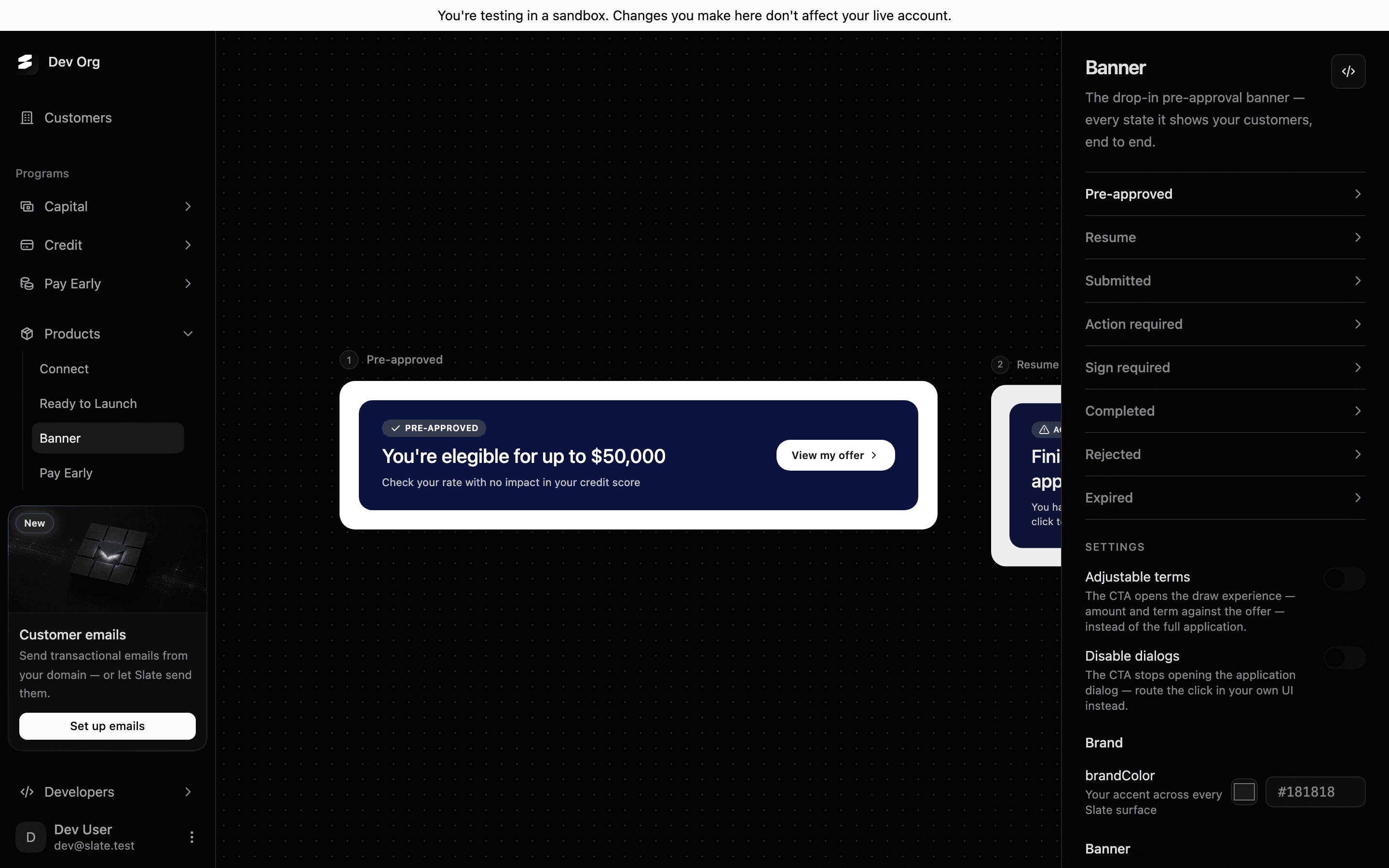
That banner is a web component. Drop it in, give it your colours, and it only appears for customers who are actually pre-approved. Everyone else sees nothing, which is the polite way to run this.
No application, and we mean it
There is no form. We score against a dated timeseries of whatever you already record, sent through one endpoint. No bank connection required to size an offer, no credit pull on the customer's file, nothing for them to upload.
When they accept, the flow is short enough to finish standing up.
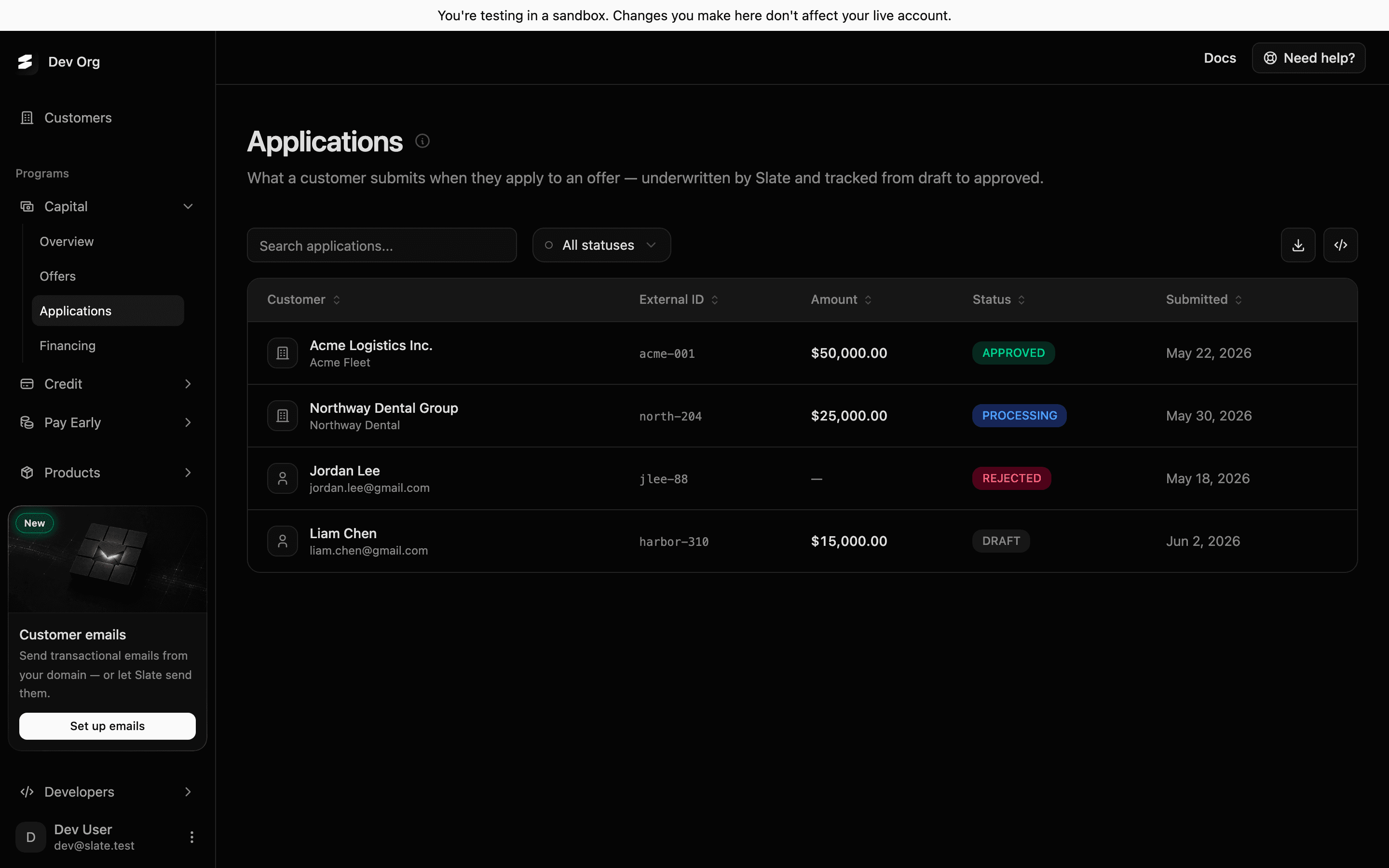
The steps you see there are yours to turn on and off. Business info, registered address, personal info, home address, ID verification. Identity verification is powered by Veriff and takes about thirty seconds.
Then it is our problem
Once the money goes out, the parts nobody wants to build start running.
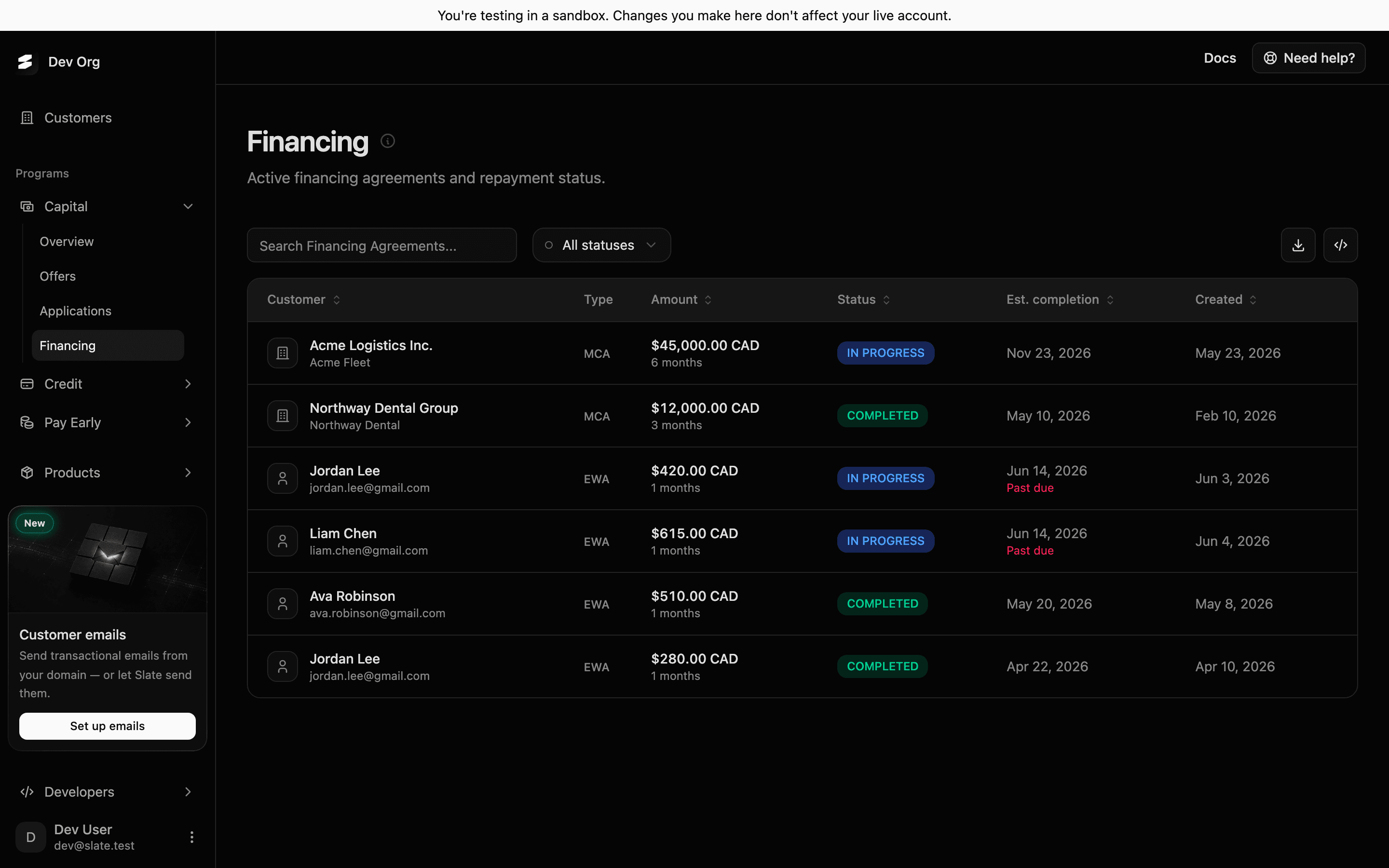
Repayment is a fixed schedule, not a slice of daily sales. The total is split evenly across the payments, the first one comes ten days plus one period after funding, and the frequency is yours to set: daily, weekly or monthly. When a payment fails, we retry it. When somebody cannot pay, our team calls them and works out a plan. Your support queue never learns any of this happened.
Money goes out within 24 hours of approval, in Canadian or US dollars.
What it costs you
Nothing to build, and nothing on your balance sheet. Every advance is funded in full through facilities we manage, and we carry the credit risk. You take a share of the spread on every advance your customers take, priced with you rather than off a rate card. It usually lands near an even split.
Three ways to turn it on
The hosted link is a page we run: no engineering, live in days. The banner and the components sit in your product: about a week and one developer. The full API is yours to build against: a few weeks and a small team.
We have partners running all three. The one thing they have in common is that none of them wrote an underwriting model.
If your platform sees money move, you already have what this needs. Talk to us and we will tell you what your book looks like before you build anything.