Credit line is live: approve once, draw whenever
Our second product. One limit sitting in your customer's account, drawn against whenever they need it, with a fixed payback shown before they tap.
Current balance
$6,240.00
Statement due Apr 10
$1,120
This cycle
Credit line
One limit, approved once, drawn against whenever they need it.
Capital has been running for five months. It does exactly what we said it would: a fixed amount, on the day it is needed, repaid on a schedule everyone agreed to first.
And then partners kept asking the same follow-up. What about the customer who needs four thousand this week, nothing next month, and eleven thousand in October? Right now they apply three times. Which is three approvals, three decisions, and three chances for the answer to be no on the day it matters.
So: the credit line. Approve once, draw whenever.
One limit, sitting there
Every customer gets a facility limit, set from the trading history your platform already records. It sits in your product doing nothing until they need it, which is the entire point. There is no second application, no re-approval, and no waiting on the day.
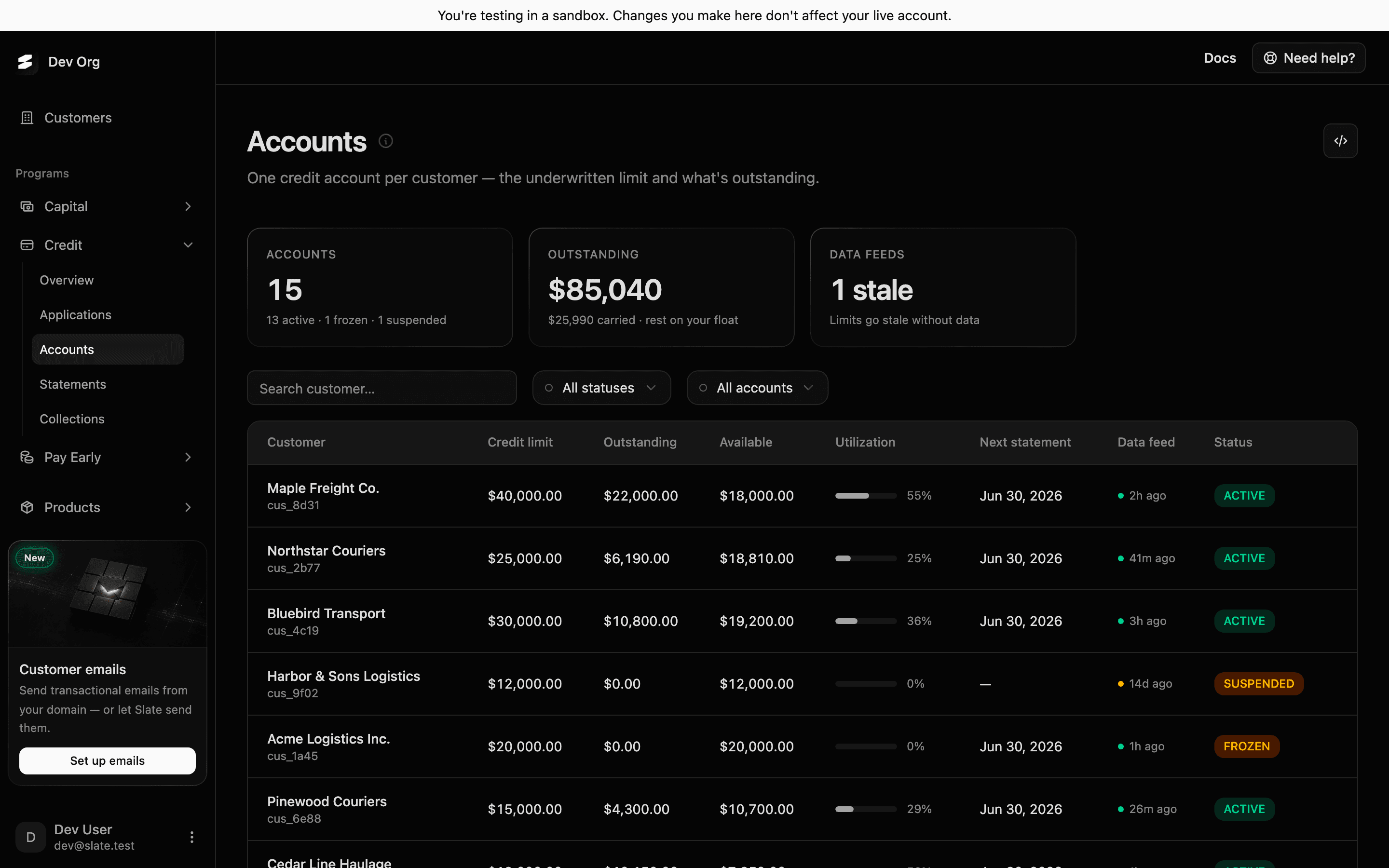
A limit is active, suspended or closed. You can see all of them, what is drawn, and where each cycle stands.
The bit we are most pleased with
Every draw carries one fixed payback amount, and we show it before they tap. Nothing accrues. Nothing compounds. There is no interest clock running in the background that turns a small draw into an argument three months later.
That is unusual enough that people assume we are hiding something, so here is the mechanic in full. Each billing cycle runs from a start date to an end date, then a grace period. Clear the statement inside the grace period and the cycle costs them nothing at all. Carry a balance past it and a factor fee applies to the part they carried, once, at finalisation. Fees are paid in full; principal is the opening balance plus whatever they drew.
There is a minimum payment. Miss it and the line suspends itself automatically at finalisation, which is the system protecting both of you without anyone having to make a phone call.
Repay it and the room comes back
This is the difference between a line and an advance, and it is the whole reason to ship it. An advance is a thing that happens once. A line is a thing your customer lives with: they draw, they repay, the room comes back, and they draw again in October without asking anyone.
For your platform that changes the shape of the relationship. Capital is an event. A line is a feature of your product that gets used all year.
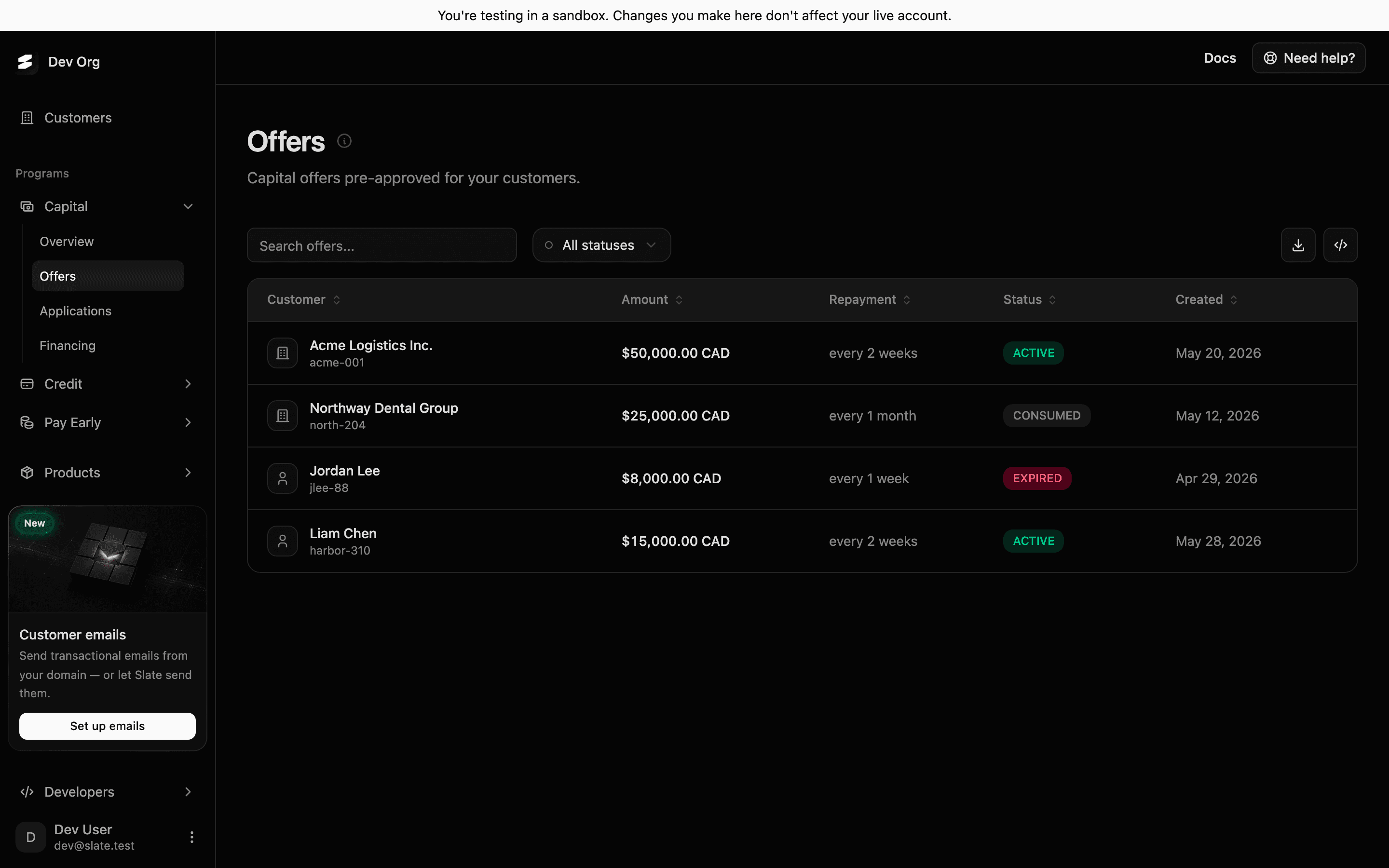
Whose book is it
Two ways to run this, and the second one is the reason a few of you have been emailing.
Ours. Slate funds every draw through facilities we manage, carries the credit risk, and does the collecting. You take a share of the spread and none of it touches your balance sheet.
Yours. You hold the receivable and Slate runs the engine underneath: the limits, the draws, the cycles, the statements, the collections. This is shipped, not theoretical. Fillip Fleet is live on exactly this shape, as lender of record on a weekly-cycle revolving line, with us underwriting and servicing it.
Nobody else in this category offers the choice. Take the first one unless you have a balance sheet and a reason.
What you build
The same thing you built for Capital, which for most of you is nothing. The offer, the drawdown, and the repayment view are components you drop in, or endpoints you build against if you would rather own every screen. One organisation runs one product at a time, so this is a decision, not a menu: Capital or credit line.
Statements generate on a cron. Cycles finalise on a cron. Neither is your problem.
If your customers have a lumpy year, this is the shape that fits it. Come and see what your book looks like as a line.