Four Times Payroll Almost Broke — And What Finally Fixed It
A founding operator's firsthand account of running payroll across borders, missing platform cutoffs, and the product gap that fintech is finally closing.
Four times payroll almost broke.
A founding operator on the cutoff nobody warns you about.
 Omar De la Rosa
It happened four times.
Not once, as a lesson. Four times, as a pattern.
I was part of the founding team at a startup, running people operations. In practice, that meant I owned payroll. Every other Friday, I was the person who knew whether the money was in the right place.
Our business ran out of the US. Our Canadian team was on a Canadian payroll platform. Every two weeks, I transferred money from the US bank to the Canadian account tied to the system.
Simple setup. Except the platform had a hard cutoff.
Miss it and payroll didn't run late. It didn't run at all. Which meant doing everything manually. Calculating each payment. Sending individual transfers. Reconciling afterward. A full workday, gone.
So I built a calendar. Wire by Tuesday. Cleared by Wednesday. Payroll submitted Thursday morning.
Except Canadian banking is slow.
Not "takes a couple of hours" slow. Slow like: you send the wire Tuesday morning, the US bank confirms it Tuesday afternoon, and you refresh the Canadian account Wednesday morning like you're waiting on a test result.
Sometimes the money was there.
Sometimes it wasn't. The platform cutoff was in four hours. The team's deposits were scheduled for Friday.
First time, I processed payroll manually. Lost most of the day.
Second time, same thing.
By the third, I kept a float in the Canadian account. A buffer. It worked — but it meant locking up capital just to babysit the speed of international banking.
Fourth time, the float wasn't enough. Manual payroll again.
Every single time, the thought was the same.
The money exists. It's on its way. I just need to run payroll now and settle it later.
That product didn't exist. So when I joined Slate, I knew exactly what we needed to build.
This isn't a rare story
I started telling this story to other operators. Finance managers. Business owners. Heads of people.
Almost all of them nodded.
Not the same scenario. But the same shape.
A restaurant whose Friday POS settlement lands after the Monday payroll cutoff.
A contractor who finished the job, invoiced the client, and runs bi-weekly payroll that doesn't care about net-30.
A dental clinic waiting on insurance reimbursements for 30 to 45 days while staff gets paid every two weeks.
A staffing agency that placed 40 workers Monday, invoices the client Friday, and needs to fund those workers before the client has even opened the invoice.
In every case: the money is real. The business isn't in trouble. The timing is just off.
And in Canada, that gap is expensive.
The part nobody explains about Canadian payroll
Most people think payroll means paying employees.
It's actually two obligations.
The first: your team gets paid. The second: you remit source deductions to the CRA — income tax, CPP, EI — on a schedule that has nothing to do with when your clients pay you.
Here's what that schedule looks like:
- Small employers (under $25K/month): due by the 15th of the following month
- Accelerated Threshold 1 ($25K–$99K): due twice a month
- Accelerated Threshold 2 ($100K+): due within 3 business days of every single pay run
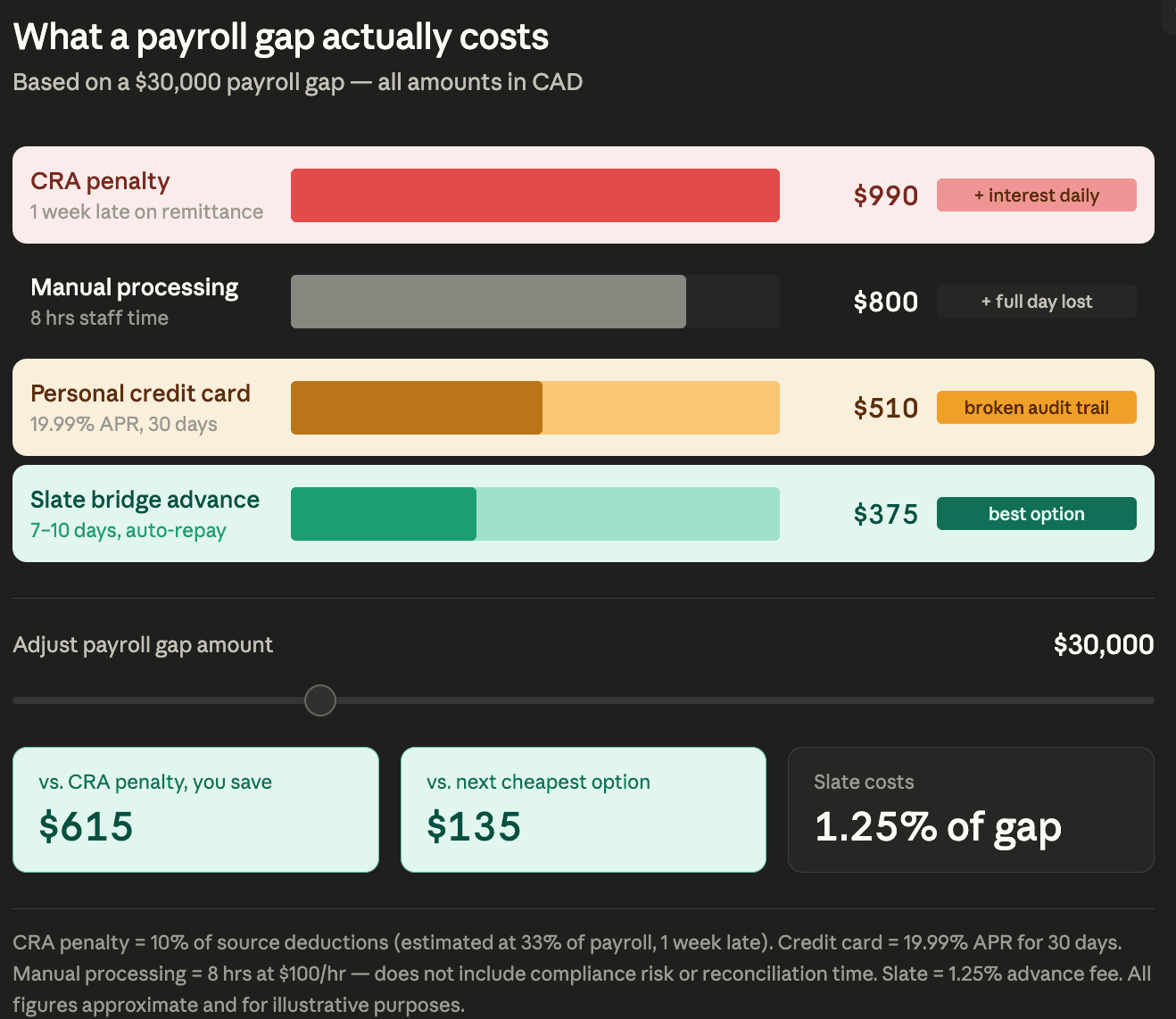
Miss it by one day: 3% penalty.
Miss it by a week: 10%.
Do it twice in a year: another 20% on top — plus daily compound interest.
A company with $60,000 in monthly payroll that misses a remittance by a week faces $2,000–$4,000 in penalties. Not because they're broke. Because a wire was slow. Because a client paid late.
The CRA doesn't care about the reason. Late is late.
According to Gusto's analysis of 6 million US small businesses (January 2026), the share of businesses unable to fund payroll on time has risen 54% since 2019. About 138,000 US businesses missed payroll in a single quarter in 2025. US penalties are softer than Canada's. Do the math.
What people actually do when this happens
I've asked a lot of people this question. The answers are always some version of the same list.
Process manually. Leave the platform. Calculate everything by hand. Send transfers one by one. Reconcile after. This is what I did, four times. It costs you a full day every time.
Use a personal credit card. Float the shortfall at 19.99%. The audit trail inside your payroll software breaks. The accountant asks questions at year-end.
Call the bank at 8am. "I need a temporary increase on my line." Sometimes yes. Sometimes no. Sometimes the manager calls back at 11am and the payroll window has closed.
Keep a permanent float. Lock up $20,000–$50,000 in a buffer account just to absorb timing gaps. This was my solution. It works. It's also capital sitting idle so a slow wire doesn't ruin someone's Friday.
Miss the remittance. Pay employees on time, submit CRA late. Pay the penalty. Watch the interest stack.
Every single one of these is worse — financially or operationally — than a simple bridge advance.
The bridge advance just didn't exist inside the software where payroll ran.

Two products that fix both sides of this
For employees: Earned Wage Access
An employee worked the hours. The wages are earned. Payday is five days away. Rent is due tomorrow.
Without EWA, the options are a payday lender at 400% annualized interest or borrowing from family.
With EWA in a payroll platform, the worker opens the app, sees what they've already earned, and requests a portion of it before the official pay run. The employer's payroll isn't touched. The worker gets their money when they need it.
For employers, this isn't charity. It signals something simple: we trust you with your own money. In a tight labour market, that matters.
For businesses: the payroll bridge
When a business is about to run payroll and the account is short, the platform surfaces one offer.
Bridge the gap now. Repay when your funds clear.
The advance is sized to the actual need. The fee is fixed. Repayment is automatic. The person running payroll never has to leave the platform, call a bank, or process transfers manually.
The advance is almost always the cheapest option. It just wasn't available inside the software where the problem was happening.
Why this belongs inside the payroll platform
The payroll platform already knows everything it needs.
Your payroll amount. Your remittance schedule. Your payment history. When your CRA deadlines fall. When your balance tends to dip before transfers clear.
A bank doesn't have this. A standalone lender doesn't either — not without weeks of statements and a formal application.
The payroll platform has it in real time, at exactly the moment the problem occurs.
That's why embedding finance in payroll isn't just a feature. It's the right place for this product to live.
Dayforce and ADP are already moving here at the enterprise end. The window for Canadian-first platforms is right now — before the enterprise players move downstream.